
Fking Singlish: Sri Lankan English Vocabulary
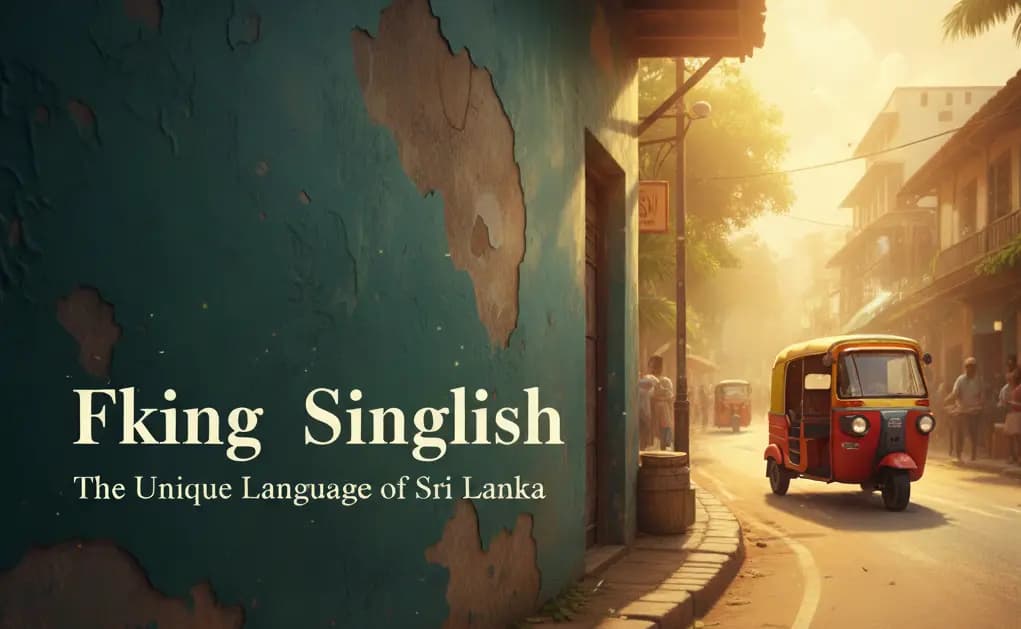
This article is about 'Singlish.' What's that, you ask? You've heard of American English (US English), Canadian English, British English (UK English), Australian English, and even Indian English. But it's hard to find articles about Sri Lankan English.
A posh Sri Lankan might say, "We use British English in Sri Lanka. Sri Lanka used to be a British Colony, hence Sri Lanka uses UK English."
Well, here’s a reality check: we don’t.
You may have chosen "English (UK)" as the system language on your electronic device, but we are far from being British. Yes, I agree, we have some British-descended habits, ideas, and traditions, and some even have the accent, but we are still further away from it than we think.
It's not well-acknowledged in our society, either. This has led to misconceptions, wrong ideologies, and many issues, misunderstandings, and problems. I myself have been penalised for it for various reasons.
So, this article is critical to my personal life. The majority of people who are reading this are likely Sri Lankan English speakers; you also might have your own similar experiences.
For someone local, you might be able to understand the distinctions and nuances of Sri Lankan English that you haven't noticed yet. And for foreigners, you can get a better, prior understanding before you run into trouble.
My "English" Background
I'll start with my early life. I did not come from an English-speaking background, but I might have had some unfair advantages: believe it or not, British-born cousins.
When they came to Sri Lanka, they used to bring resources, such as BBC TV show recordings or stuff they did day-to-day. I wasn't much interested in the latter, but I loved the TV shows and cartoons. But there were times we didn't have a TV in the house. In those days, my mom used to read books to me—English books as well as others. By age 6, I was able to read by myself.
And since then, I started learning. But up until grade 6, I attended a Sinhala-only school. So I had no way to interact with Sri Lankan English-speaking people.
Although, in grade 5, after the scholarship exam, I had another odd, different, and (for me) still unacceptable experience. We had 'dictations'—which in Sri Lanka, by the way, is simply our term for a spelling test. I mostly got 9/10 or 10/10. But on one particular day, one word was marked wrong, even though I knew it was correct. My friend pointed it out to the teacher.
I later realised the issue was how I wrote the letter "t." I used to write it like "†". The teacher then hit me until I could feel blood in my throat. Back then, I didn't tell anyone about this. But I knew I was not a particularly bad student. She asked me to write it again and again, without even explaining to me how it was supposed to be written. And every time I wrote it wrong, she hit me again.
For a long time, I thought it was a serious issue. I later figured out it's not. It's just another way of writing 't'.
First Contact with Singlish
Somehow, I entered secondary school and started learning in the English medium. That was my first interaction with so-called Sri Lankan English. For the first few days, I understood absolutely nothing.
By that time, I had the knowledge and could understand what was being discussed in a talk show or follow a conversation happening in English. But the way they spoke puzzled me completely.
The Singlish Dictionary: Common Words & Phrases
This brings me to the specific examples.
1. The "No?" Conundrum (neh?)
This was purely my science teacher. She used to talk in a way where, at the end of every sentence, she would say "no." Or sometimes "no-ah... no." At the time, I hadn't heard the word. I questioned a friend of mine about it, who had attended an English primary college. He explained to me that it's "know."
At the time, his explanation made total sense. It's what you'd call a 'folk etymology'—an explanation that sounds plausible but isn't the real origin. It's easy to see why he thought that. In British and American English, people do use "you know?" in a similar way (e.g: "So I went to the shop, you know?").
But the truth is, what my teacher was doing is a classic example of a "calque," or a direct loan translation. We are, quite literally, taking our local sentence structure and just swapping the words for English ones.
You're completely correct that it's a substitute for the Sinhala "neh?" (or né?).
- Sinhala: "Ada rassnei, neh?" (Today it's hot, isn't it?)
- Sri Lankan English: "It's hot today, no?"
We just grabbed the simplest, shortest English negative ("no") to fill the grammatical slot that "neh?" holds. It's not seeking "knowledge" (from "know"); it's seeking agreement, just like "neh?".
So, my friend was right about its function—which is why it made sense to me—but the word itself is just "no." The more I interacted with a Sri Lankan English-speaking audience, the more I started to understand these nuances.
2. Hotel (vs. Restaurant)
This is a common one. It took me a long time to catch. For me, a "hotel" was always somewhere you eat. But that’s only in Sri Lanka. I later figured out that internationally, a "hotel" is somewhere you stay or spend the night—a fancy place to stay when you move to another city. What we call a "hotel" is actually a "restaurant" or "café."
3. Keep (vs. Put/Place)
Then there's the verb that confused me: "keep." They usually say, "Keep it on the table" instead of "Put it/place it on the table." In reality, "keep" means to retain possession of something or to continue to have it. For example, "Keep this book, it's yours" or "Keep the change."
But in Sri Lankan English, "keep" is commonly used to mean "place" or "put." I remember someone (maybe Harith) made an English version of the song “Ada Ape Thaththa”. For the part that said “Today our father came home and stamped his foot on the ground”, they translated it to, “Keep the foot on the floor.” I always questioned if that was right. But, you know, it rhymed, and for some, if something is rhyming, it’s true.
4. Cousin-Brother / Cousin-Sister
When the time passed, I met a friend called Sanjaya. He was one of the first people I started texting with because, back then, my parents were exceptionally understanding and gave us good freedom with phones when many of my friends weren't allowed them.
Somehow, he kept referring to coming to class with his "cousin-sister." Prior to that, I had never assigned a sex to the word "cousin." I thought "cousin" was a unisex word. But it turned out, in his world, it wasn't. Then, when I later had a conversation with a Canadian, he questioned this when I mentioned the word "cousin-brother." That's when I found out it's just a South Asian thing, not a global one. Globally, "cousin" is not a gender-specific noun.
5. Current (Electricity)
The word "current" has a unique definition for itself in the South Asian region. Here in South Asia and Sri Lanka, "current" means electricity. If a Sri Lankan tells you there is "no current," don't imagine they're having an existential crisis about the present moment. It means we have a power outage, or a blackout.
6. Vegetables (Brinjal & Lady's Fingers)
For this, the list could go on. The funniest one is "brinjal." It’s a South Asian English word as well. "Brinjal" means aubergine (or "eggplant" in American English). And the vegetable "okra"—in Sri Lanka, it’s commonly known as "lady's fingers". I found out that in some countries, they use the same word.
7. Shorteats
I think this is very unique to Sri Lanka. This is the word for snacks like rolls, "patties", samosas, "vege roti," or "vada." These are what we call "shorteats." Not necessarily packeted snacks, but more like street foods. I can guarantee you, they are the most delicious. If you are a traveller, please try them.
8. Plain Tea / Plain Coffee
This was taught to me by my dad. In small Sri Lankan restaurants, if you order "a tea," they will bring you a tea-and-milk beverage. I personally don't drink milk, so this is a problem for me. If you want black tea (Ceylon tea), you must order a "plain tea." The same works for coffee. Just order "plain coffee."
9. Petrol Shed (Gas Station)
This one is funny because most Sri Lankans pronounce "shed" with a "z" sound (or 'sed'). This refers to a gas station. I remember my grandfather told me that back in the '60s or '70s, filling stations in Sri Lanka were also called "gas stations" . But back then, they had cars that literally ran on gas (like the LP gas we use today, not liquid). When that went out of usage, they started using "Petrol Shed," "filling station," or "Petrol Station." Although, I am sure if you ask a local for directions to a "filling station" or "gas station," they mostly would not be familiar with those words.
10. Outstation
I got to know this word when I started working. In my work, I had to phone call a couple of company owners. It's mostly their assistants who answer the phone. Sometimes they say, "The boss is outstation." I asked my manager, and it meant he was away from Colombo. I really recommend you go "outstation" if you ever want to travel in Sri Lanka!
11. Batch Mate
This started with my cousin—well, the eldest cousin-sister on my maternal side. She was the first one to enter a university from my mom's family. At that time, she introduced her friends as "batchmates." I accepted it as a real word. But it turns out it’s just used in Sri Lanka. It means a peer who studies in the same graduation year.
12. Pass Out (vs. Graduate)
This is what you call a university graduate. So if you are a graduate, you have "passed out" from the uni. But in standard English, "pass out" actually means to faint or lose consciousness. So when Sri Lankans say, "I passed out from university in 2015," people from other countries might think you fainted during graduation! The international term is simply "graduated from university."
13. Ragging (Hazing)
This is a word that carries serious weight in Sri Lankan universities and schools. In Sri Lankan English, "ragging" refers to the practice of hazing or bullying, particularly of new students by senior students. It's unfortunately been a dark tradition in many universities, where "freshers" (first-year students) are subjected to physical or mental harassment as a form of "initiation." While ragging has been officially banned and is illegal in Sri Lanka, the word itself is uniquely South Asian. In standard British or American English, people would use terms like "hazing," "bullying," or "initiation rituals" instead. The word "ragging" in other English-speaking countries simply means teasing or joking around in a playful way, which is completely different from the serious issue it represents in Sri Lanka.
14. Going Down / Going Up
This is another uniquely Sri Lankan phrase that confused me for quite some time. In Sri Lankan English, when someone says "I'm going down," they typically mean they're heading to the southern part of the country, particularly to coastal areas like Galle, Matara, or Tangalle. Similarly, "going up" means traveling to the northern or hill country regions. This directional language makes sense geographically—the south is literally "down" on the map, and the elevation drops as you head to the coast.
However, in standard English, "going down" simply means descending physically (like going downstairs). I remember being thoroughly confused when my friend said, "We're going down this weekend," and I couldn't understand why they were so excited about going downstairs. It wasn't until they showed me beach photos that I realized they meant they were heading to the southern coast.
For visitors to Sri Lanka, if someone invites you to "go down," pack your swimsuit—you're probably headed to some beautiful beaches!
15. Tuk-Tuk
This is the affectionate name Sri Lankans use for three-wheelers, those iconic motorized rickshaws that zip through the streets of every city and town. While "tuk-tuk" is also used in Thailand and other parts of Southeast Asia, it's become such an integral part of Sri Lankan vocabulary that locals rarely use the formal term "three-wheeler." The name comes from the distinctive "tuk-tuk-tuk" sound the engine makes. If you're visiting Sri Lanka, hopping in a tuk-tuk is practically a rite of passage—just remember to negotiate the fare before you start your journey!
16. Today Morning / Yesterday Night
Ah yes, the time expressions that make English teachers worldwide cringe in unison. In Sri Lankan English, we cheerfully say "today morning" when we mean "this morning," and "yesterday night" instead of "last night." It's perfectly logical if you think about it—if we can say "yesterday afternoon" and "tomorrow morning," why can't we say "yesterday night" and "today morning"?
Well, apparently standard English has some arbitrary rules about this. When I first learned that "today morning" wasn't correct, I was genuinely baffled. I mean, the morning happened today, didn't it? And that night definitely happened yesterday! But no, apparently you're supposed to say "this morning" and "last night." It's one of those quirks where Sri Lankan English actually makes more sense than standard English, but we're the ones who get corrected.
My favourite moment was when I told my British colleague, "I couldn't sleep yesterday night," and he spent five minutes explaining why it should be "last night." I nodded politely while thinking, "But the night was literally yesterday, mate." To this day, I still slip up and say "today morning" because honestly, it just feels more natural. If you're a Sri Lankan reading this, you probably didn't even realize this was "wrong" until now. Welcome to the club!
17. Kottu Roti
This is one of Sri Lanka's most iconic street foods, and the name itself is uniquely Sri Lankan. "Kottu" (also spelled "kothu") comes from the Tamil word meaning "chopped," and that's exactly what it is—chopped roti mixed with vegetables, eggs, and usually meat, all stir-fried together on a hot griddle with a rhythmic clang-clang-clang of metal spatulas that you can hear from blocks away. If you're visiting Sri Lanka and haven't tried kottu roti, you're missing out on one of the most delicious experiences the island has to offer!
18. Aiyo
This is probably one of the most versatile and expressive words in Sri Lankan English. "Aiyo" is an exclamation that can mean anything from surprise to dismay, sympathy to frustration, depending on how you say it. It's borrowed from Tamil and Sinhala, and it's so embedded in Sri Lankan speech that even English conversations are peppered with it. "Aiyo, I forgot my keys!" "Aiyo, that's so sad!" "Aiyo, why did you do that?" It's the Swiss Army knife of Sri Lankan expressions. Foreigners who spend time in Sri Lanka inevitably pick it up because it's just so useful and infectious.
19. Put (vs. Turn On)
In standard English, "put" means to place something somewhere. But in Sri Lankan English, it has an extended meaning related to switching things on. "Put the light" means turn on the light. "Put the fan" means switch on the fan. I never realized this was unique to us until a confused American friend asked me, "Put the light where?" when I asked him to turn on the light switch. The correct standard English would be "turn on" or "switch on," but for Sri Lankans, "put" works perfectly fine for this purpose.
20. Purse (Wallet)
In Sri Lankan English, both men and women can carry a "purse," and it simply means a wallet. But in American English, a "purse" specifically refers to a woman's handbag, which would be very confusing if a Sri Lankan man casually mentions, "I left my purse at home." In the US, this would sound like he carries a handbag! The correct international term for what Sri Lankans call a purse would be "wallet."
21. Scheme (Housing Development)
In standard English, "scheme" often has negative connotations—it suggests a devious plan or conspiracy. But in Sri Lankan English, "scheme" is used more neutrally to refer to any housing development or residential area, borrowed from British colonial planning terminology. "I live in a housing scheme near Nugegoda" simply means "I live in a housing development," with no sinister undertones whatsoever.
These Aren't 'Mistakes'—It's Our Language
So there you have it—a glimpse into the wonderfully weird world of Sri Lankan English. We've kept many of our British spellings while developing our own vocabulary, borrowed from Sinhala, Tamil, and sheer creativity. We've turned "keep" into a multipurpose verb, made "current" mean electricity, and created time expressions that make more logical sense than standard English (fight me on "today morning").
The thing is, these aren't mistakes. They're not signs that we're speaking English "wrong." This is simply how language evolves when it meets different cultures, climates, and contexts. Sri Lankan English is a legitimate variety of English, shaped by our history, our multilingualism, and our unique way of seeing the world. It's how we've made this colonial language our own.
A Final Thought
To my fellow Sri Lankans: Embrace it. Yes, learn standard English for international communication, but don't feel ashamed of our local flavour. When you say "today morning" or ask someone to "put the light," you're speaking a version of English that's uniquely ours, one that carries the weight of our culture and experience.
To visitors and foreigners: If you're confused by how we speak, just ask. We're usually more than happy to explain. And please, try the kottu and the shorteats. Go "down" to the south. Take a tuk-tuk. Experience not just our language, but the vibrant, chaotic, beautiful culture it represents.
And finally, if a Sri Lankan tells you they "passed out" from university, please don't call an ambulance. Just congratulate them on their graduation.
One last thing: let's stop shaming people for how they speak English. Language shaming only perpetuates colonial mentalities and damages people's confidence. If someone communicates their message clearly, that's what matters—not whether they follow British grammar rules. Our variety of English is valid, and so is everyone's attempt to communicate in it.
That's all from me. Thanks for reading.
Enjoyed this article?
Subscribe for new chronicles. No spam — just the good stuff.
Join the WhatsApp Channel
Get updates & new posts straight to your WhatsApp. No spam.