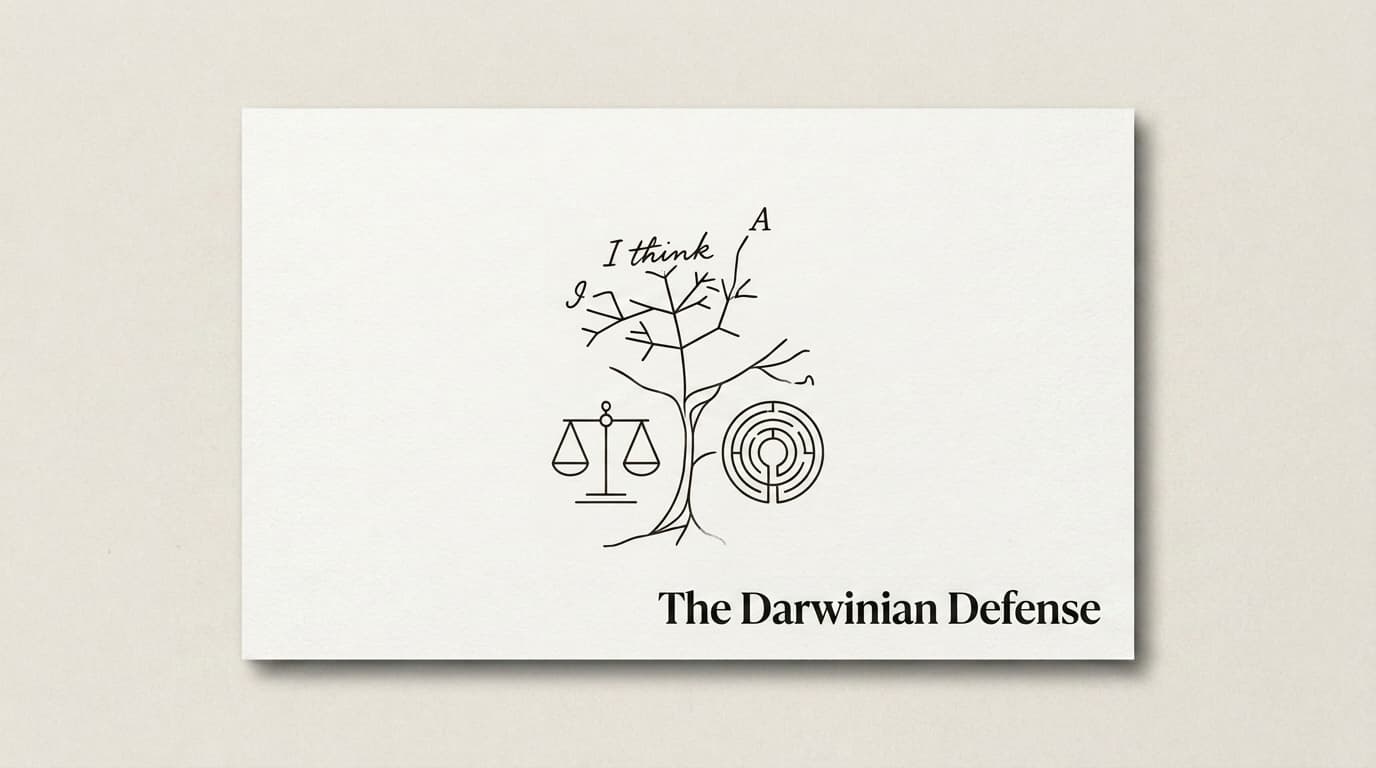
The Darwinian Defense
Some people are built for rooms full of strangers. I am built for the walk home.
There are two kinds of people at a university party.
The first kind arrive as if summoned by an invisible bell. They step into the room, exchange three words with someone holding a plastic cup, and dissolve into the noise with an effortless ease I have spent my entire life admiring from across the floor. They are, in short, made for this.
The second kind arrive with the best of intentions. They shake a few hands, make polite conversation with someone about an assignment neither of them has started, sign the mental register to prove they were technically present, and then slip quietly out the front door before the first bassline has even finished warming up.
I am, rather firmly, the second kind.
A Question in the Dark
A few weeks ago, our campus threw one of those DJ nights everyone spends a week talking about beforehand. I actually like dancing, moving to a beat is one of the few times my brain goes quiet. But that night, something in me wanted the opposite of noise. I did not retreat to a veranda or linger in the corridors. I simply went back to my room, clicked the light switch off, and lay down on my bed in the dark with my earphones in.
I let Lana Del Rey take over.
There is a particular variety of peace that lives inside chosen solitude. Loneliness is wanting someone in the room who isn’t there, chosen solitude is closing the door yourself, laying down the heavy social armor you’ve been carrying all evening, and breathing in the silence like cool air. One is an ache. The other is, in its own quiet way, a superpower.
I was lying there, staring up at a ceiling I could not see, quietly untangling the strange feeling of not quite fitting in, when the screen of my phone lit up the room.
A message. From a friend.
It was not a casual evening check-in. Something genuinely frightening had happened earlier that day.
She had unexpectedly crossed paths with an ex-partner, someone from a painful past chapter who had cornered her into a conversation she never wanted to have. In a burst of panic and disgust, she had fled the scene, but moments later her phone rang from an unfamiliar number. When she answered, every drop of suppressed fury came rushing out. She told him, in no uncertain terms, that she despised him. And in the heat of that raw, trembling anger, she said the words that almost everyone dreads saying in the moment: she told him to go disappear, to end his own life.
Hours later, the fury had evaporated, leaving behind a cold, sickening dread.
“Do you think he will actually do it?” she asked me. “What if he destroys himself?”
She was terrified that a tragedy was about to unfold, and that she would carry the guilt of his death on her conscience for the rest of her days.
I sat up in the dark.
And then, because my brain processes reality the way it does, I offered her an answer rooted in Charles Darwin.
Before I tell you what I said, I should make one thing abundantly clear: I am not, by design, a cold person.
In fact, if you had known me in primary school, you would have found me almost inconveniently fragile. If the teacher raised her voice to scold the boy sitting at the desk next to mine, my own eyes would fill with tears. I absorbed other people’s distress as if it were a physical blow.
I still remember traveling through Homagama junction with my mother when I was small. I saw an old man on the pavement, begging in the midday heat. A sudden wave of sorrow hit me so hard that I reached into my pocket, desperate to give him whatever small coins we had, but my mother gently pulled my hand away and kept walking. That brief encounter lodged itself so deeply in my chest that I cried long after we had returned home.
So what happened to that boy?
Nothing dramatic, really. He simply discovered that feeling everything at maximum volume, without a filter, is an unsustainable way to live in a chaotic world. To survive, I built a firewall. Over time, raw human emotions began passing through an internal translation service: messy, terrifying feelings go in one side, and on the other side emerges a structured, logical framework.
Think of it as an intellectual shock absorber. Marcus Aurelius, the Roman emperor who wrote philosophy in his military tent to keep his wits during war and plague, called this amor fati, a radical acceptance of reality as it is, not as we wish it to be. He practiced negative visualization actively contemplating the worst that could happen, even the death of loved ones, not out of morbid indifference, but so that the arrival of disaster could never ambush his soul.
It is a remarkably effective defense. But it tends to sound rather startling when spoken out loud.
The Theory of Natural Selection
To understand the advice I gave, one must look at Darwin’s theory of natural selection, not as a dusty chapter in a high school biology textbook, but as the fundamental operating system of life.
Imagine a herd of gazelles living on a savannah alongside cheetahs. The gazelles are not all carbon copies of one another, some are slightly swifter, some have sharper hearing, and some are slower. The cheetahs, needing to eat, naturally catch the slower gazelles. It sounds brutal, but the result is that the faster gazelles survive, reproduce, and pass their speed on to their offspring. Over countless generations, the entire species becomes faster, more alert, and better equipped to stay alive.
Natural selection rests on four remarkably simple principles:
- Variation: Every individual in a species is slightly different.
- Struggle: Resources are limited, and life is inherently hazardous.
- Adaptation: Those who possess traits suited to navigating the hazards endure.
- Inheritance: The survivors pass those winning traits to the next generation, while the traits that failed to adapt are quietly filtered out.
It is nature’s impartial algorithm. Nature has no malice, but neither does it have sympathy. It cares only about whether an organism adapts to its environment or breaks under the pressure.
Sitting on my bed, with the dark room wrapped around me, I applied that exact evolutionary filter to my friend's crisis.
I told her that the world, by its very nature, is neither fair nor kind. We are still evolving creatures, subject to the same ancient laws of survival. If an individual chooses to destroy themselves over a phone call or a broken relationship, that is their own internal struggle with reality, a tragic failure of emotional adaptation. We cannot be held spiritually or legally hostage by someone else's inability to survive life's friction.
“Survival by natural selection, as Darwin said,” I typed into the glowing screen. “The ones that fight and figure out a way to survive, will do so. And generations will learn from those who didn’t.”
I even sent her the Wikipedia link to the definition of Natural Selection, adding: “Before you blame me, this was Darwin. Not me. I’m just the messenger.”
She replied quietly: “Appreciate your inputs. Goodnight.”
The screen went black. I was left alone in the dark with the hum of the ceiling fan.
I have thought about that exchange many times since.
Some might look at what I said and call it callous. Others might call it clinical. Either way, I didn't lie to her. I told her the plain, unvarnished truth as I understand it.
Consider how the game of survival has transformed. For our hunter-gatherer ancestors huddled around a fire in a cave, survival was almost entirely physical, finding calories, outrunning predators, and enduring the winter cold. Within those small bands, human connection was immediate and absolute, you lived and died by the trust of your tribe.
Today, in our modern civilization, physical survival is mostly solved by supermarkets and concrete roofs. But evolution did not pack up its bags and go home, it simply shifted the battlefield.
Today, survival is a contest of emotional tolerance, pressure tolerance, and cognitive resilience. We are bombarded by economic demands, social expectations, and hyper-connected anxieties that our stone-age nervous systems were never engineered to carry. Just as ancient Greek citizens had to invent Stoicism to keep from losing their minds inside the noise of their emerging Mediterranean cities, we are forced to build our own mental armor to survive ours.
Humans are communal creatures by nature, we are built to look out for one another. When someone is weak or stumbling, offering a hand is one of the noblest things we can do. Society only progresses when we protect the vulnerable.
Yet, there is a distinct boundary between helping someone carry their load and sacrificing yourself to become their crutch. In books and cinema, we are taught to romanticize self-destruction, the grand martyr who throws their life away for love. To lay down one’s life to save millions from a burning building is heroic. But to destroy your own mental sanity, or your own life, over the demands of a single broken relationship? That is not heroism. That is a failure to adapt to the reality of the human condition.
The Powerful Play Goes On
As the wonderful lines by Walt Whitman (immortalized by Mr. Keating in Dead Poets Society) remind us:
“That you are here, that life exists and identity,
That the powerful play goes on, and you may contribute a verse.”
The play of existence will continue, with all its chaotic acts, its heartbreaks, and its triumphs. But here is the crux: you are only responsible for your own verse. You cannot write someone else's lines for them, nor should you allow another actor to tear down your stage because they have forgotten their own part.
Did I give my friend the best advice that night?
I genuinely do not know.
Perhaps she needed a softer shoulder rather than a biology lesson. Or perhaps what she needed most was the sharp slap of objective reality, a reminder that another adult’s choices do not belong to her conscience. When the world is screaming with subjective panic, stepping back to view things as an objective dataset isn't cruelty, sometimes, it is the only way to keep from drowning alongside them.
We can care deeply about people while acknowledging that we do not control their fate. We can offer our warmth without letting it burn down the house we live in.
I leave this question to you:
When someone you care about is overwhelmed by emotional chaos, is it kinder to offer them unconditional emotional comfort, or the cold, liberating truth of objective reality? Where do you draw the line between being compassionate and letting someone else's inability to adapt pull you under?
I’d love to read your thoughts in the comments below.
~ KH
Enjoyed this article?
Subscribe for new chronicles. No spam — just the good stuff.
Join the WhatsApp Channel
Get updates & new posts straight to your WhatsApp. No spam.