
ChatGPT was released on my 18th birthday
Hey earthlings. This one is about AI, and about me, and about why those two things became the same story.
Let's start from the very beginning.
I was a curious kid. In the polite, manageable way that adults find charming, but in the relentless, why-does-everything-work way that probably exhausted everyone around me. I had a very good imagination, and from a very young age I carried this possibly delusional belief that nothing is truly impossible. I still carry it today.
The house I grew up in did not have electricity, at least not in the early years. No tap water either. We had a well, which I think is partly why my mother and grandmother became such quietly strong women. For light, we had a PetrolMax lamp. It ran on kerosene and could burn for about seven nights without stopping. My maternal grandfather was the one who lit it. He never once let me touch it. I would just watch, fascinated by the ritual of it, by the fact that burning liquid could become something as clean and steady as light.
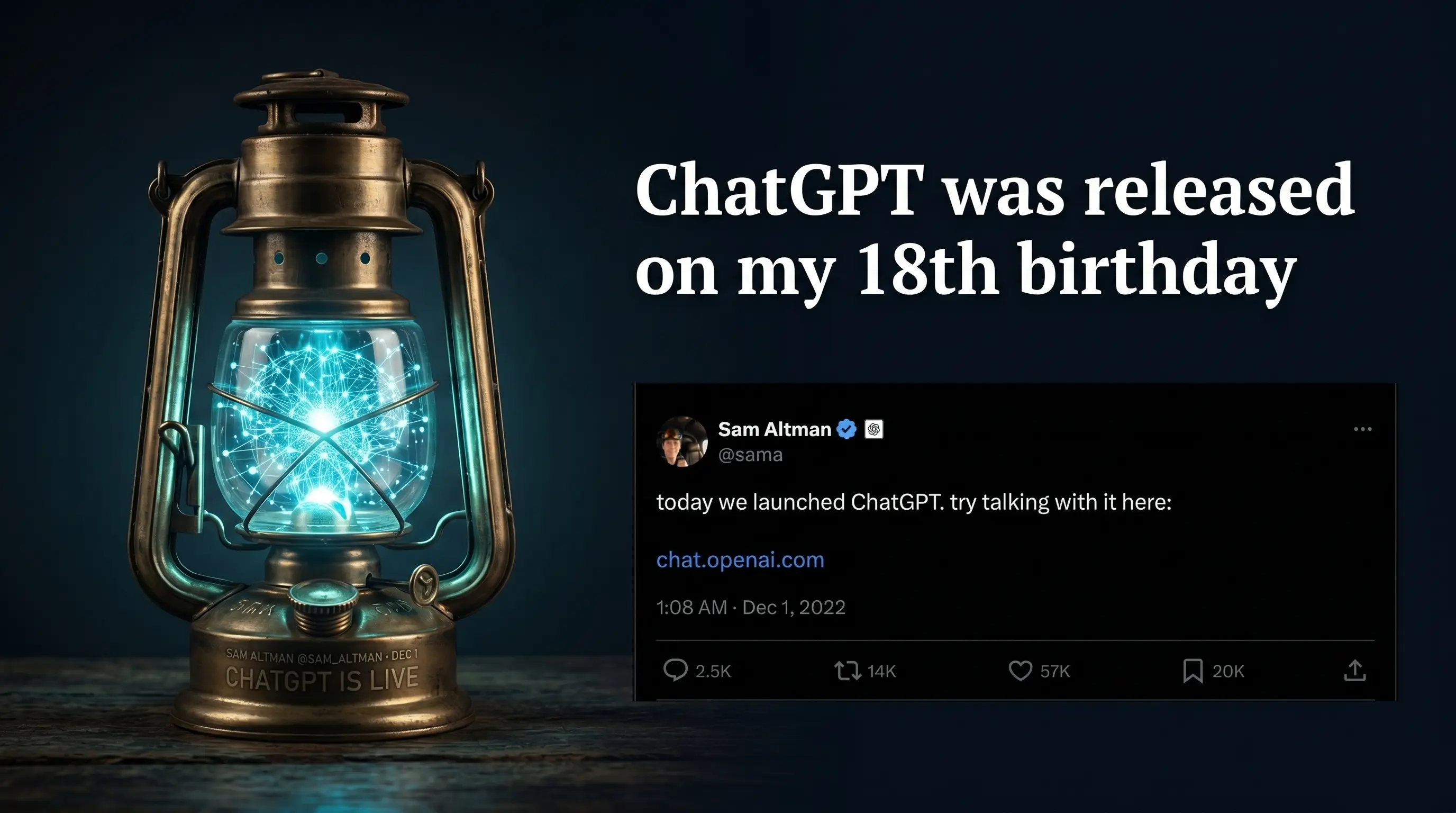
(If you have never seen one, this is exactly what it looked and sounded like.)
Then one day, we got electricity.
I remember my dad wiring everything himself. And when that first light bulb came on, something shifted in my head. If we could do that, what else could we do? My little mind had no ceiling. When my mother asked me what I wanted in the world, I asked for two things: a switch to stop rain whenever I wanted, and a switch to bring my dad home from work. I later figured out my dad could not afford those two switches. No dad could.
But the wanting never stopped.
By grade five I was deep into science experiments. Magnets. Electricity. Currents. Biology. I was fascinated not just by how things worked, but by the people who figured them out first. What did it feel like to discover something that no one in the history of the world had ever seen before? I started reading biographies. Scientists, mostly. It became a habit.
Grade eight brought something new. A friend named Isiwara introduced me to the school's Software Club. The sessions ran on tutorial videos presented by a woman named Taylor, American accent and all, which was genuinely unfamiliar to me at the time. She was teaching Google CS First, a program built around Scratch. Game design, from scratch. I was hooked immediately and briefly convinced I would become a game designer before anyone else thought to try.
Academics had other plans. The O/L years pulled me away from screens and into textbooks, and for a while technology took a back seat. What kept me going during that stretch was reading. Science books, mostly. One of them was Hello World by Hannah Fry.
That book is where my interest in AI actually began. Fry writes about the history of AI, and the ways it had already quietly changed the world, and she made it feel urgent and human rather than distant. But reading it also left me with a low-grade frustration. The field felt slow. Underfunded. Like something genuinely important was being left to simmer when it deserved a proper fire under it.
By late 2022 I was in my first year of highschool, studying physical sciences, and spending probably too much time on my MacBook chasing ideas that had nothing to do with the syllabus. One of those ideas was finding a tool that could help me write more cleanly, because I have always found my own mistakes while writing annoying enough to stop me mid-thought. That search led me to OpenAI. I found GPT, the earlier version, the one where you gave it a topic and it produced an essay. It was useful, honestly. Not dramatic, but useful.
And then in December 2022, they released ChatGPT.
ChatGPT technically launched on November 30th. But on December 1st, Sam Altman tweeted about it. December 1st is my 18th birthday. I did not know this for a while. But when I found out, something about it felt like a small joke the universe had decided to play on me, the kind that only makes sense in hindsight. The field I had been watching impatiently for years had chosen my 18th birthday to announce itself to the world. I don't know what to do with that coincidence except write about it.
I remember playing with it in those early days. I did not yet understand the architecture, and I definitely did not see the full scale of what was coming. But I knew it was fun. I talked to my close friend Tara about it. We had been speculating for a while about whether an AI could actually hold a real conversation, and here was the answer, or at least the beginning of one. I introduced her to it. She was as surprised as I was. We both laughed at how strange it felt, like meeting something that should not exist yet.
I have spent a lot of time with AI since then. It started with curiosity and became something closer to a vocation. I went from using it for small writing tasks to building with it, coding with it, eventually co-founding a company that builds AI-driven systems. The jump from "this is fun" to "this is what I want to work on" happened faster than I expected, and mostly by following the questions I could not stop asking.
That time has also given me a fairly specific opinion about how most people use it wrong.
The most common mistake is treating it as a source of truth. It is not. At its core, a large language model is a very sophisticated pattern machine. It has been trained on enormous amounts of text, and when you give it a prompt, it produces the sequence of words that is statistically most likely to follow, given everything it has learned. That is genuinely impressive, and it is also genuinely not the same as knowing things. The transformer architecture, first described in Google's 2017 paper "Attention Is All You Need," is what makes this possible at scale. But architecture does not equal accuracy.
There are two failure modes worth understanding. The first is hallucination: the model confidently producing something that is simply not true, because it is optimising for plausibility, not correctness. The second is misaligned specification, which is more of a philosophical problem. If you ask a system to "remove all evil from the world" without careful constraints, a sufficiently literal system might reason its way to a conclusion you did not want. Neither of these is a reason to stop using AI. They are reasons to think carefully about how you use it.
The frame I find most useful: treat it like a very fast, very capable collaborator who needs clear instructions and healthy scepticism. Tell it exactly what you want, in what format, with what constraints. The more specific you are, the better the output. That is true for any tool, honestly. AI just makes the gap between good instructions and bad ones unusually visible.
I turned 18 the same day Sam Altman told the world ChatGPT existed. I did not know then how much of my next few years would be shaped by that technology, or that I would eventually be building with it, studying it, arguing about it, and trying to understand what it actually is under the hood. But the curiosity has always been the same thread. It started with a PetrolMax lamp in a house without electricity, and a kid who wanted two impossible switches. The switches were always beside the point. The wanting was the thing.
Enjoyed this article?
Subscribe for new chronicles. No spam — just the good stuff.
Join the WhatsApp Channel
Get updates & new posts straight to your WhatsApp. No spam.
Comments
You Might Also Like
Iran War: Everything you should know about it as a Rational Thinker
The unwritten rules of global warfare just vanished. Following an unprecedented decapitation strike on Iran's leadership, we are witnessing a terrifying paradigm shift. From the economic domino effect of asymmetric proxy wars to the chilling reality of AI-driven military escalation, explore the undeniable mathematics of our fragile new multipolar world.

How I Ended Up Here
The story of how I balanced student life, discovered Ikigai, and built an AI startup. A personal journey of passion, automation, and finding my path at SLIIT.
The Automation Paradox
Why fear, not complexity, is the biggest threat to business. A look into the core of automation and the resistance holding companies back.