Why Scientists Hate Tech Giants: A Student’s Perspective
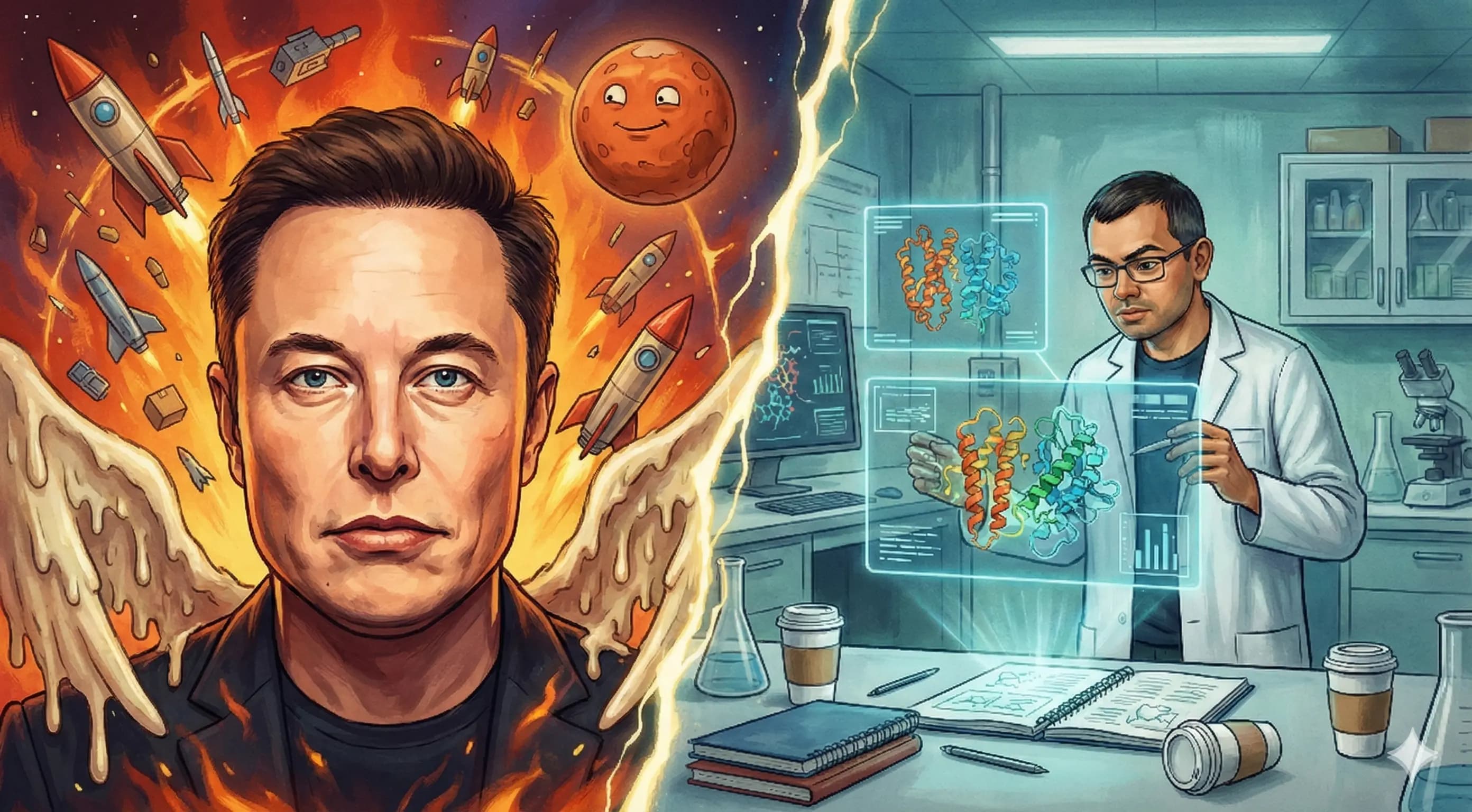
We often think we must choose between the exciting magic of the storyteller and the cold hard facts of the scientist, but true progress - the kind that wins Nobel Prizes - happens when we have the courage to dream and the discipline to do the math.
I sat down to write today with a feeling I can only describe as "butterflies." It is that nervous, fluttery sensation you get when you are standing at the edge of something big.
You see, I am not a tycoon with a skyscraper in Colombo. I am a student. I am an aspirational entrepreneur, still in university, still learning, still trying to find my footing in a world that seems to be shouting two very different instructions at me.
On one side, I have always loved science. I believe science is the fundamental truth of the universe. Whether we believe in gravity or not, it is there, holding us down. But on the other side, I have a burning desire to build things. I want to create a startup. I want to be part of the future.
And this is where the trouble begins.
The Clash of the Titans
Growing up, like many of us, I looked at the "Tech Giants" - people like Elon Musk or Sam Altman - as modern-day wizards. They promised us Mars colonies, brain chips, and super-intelligent computers. They were the heroes of the story.
But recently, I noticed something rather unsettling. The people I respect most in the intellectual world - the serious scientists, the professors, the deep thinkers - seem to be very unhappy with these Tech Giants.
At first, I thought the scientists were just being grumpy. I thought, "Why do they hate progress? Why are they complaining?" I thought they were just jealous of the money and the power.
But now that I am older, and perhaps a tiny bit wiser, I dug deeper. I watched a fascinating discussion on StarTalk with Neil deGrasse Tyson and Adam Becker , and it felt like someone had poured a bucket of cold water over my head. They weren't hating on technology; they were pointing out that the Emperor had no clothes.
They explained that living on Mars isn't just a "hard challenge"; it is a radioactive nightmare where the soil is toxic. They explained that you cannot simply wish for technology to improve forever just because a graph says so.
I was left with a terrible question: Do I have to choose?
Do I have to be a "boring," safe scientist who never takes a risk? Or do I have to be a "reckless" entrepreneur who ignores reality to sell a dream?
The Man with the Wax Wings
To understand why the scientists are so angry, I had to create a picture in my mind. An analogy, if you will.
Imagine two people standing on a cliff edge in the 19th century. They both want to fly.
The first man is the Dogmatic Entrepreneur - let's call him the Alchemist. He builds a pair of wings out of wax and feathers. He shouts, "I believe I can fly! If I just have enough courage, the laws of physics will bend for me!" He jumps. Now, if he catches a lucky wind, he might glide for a moment and look magnificent. But usually, the sun melts the wax, and he crashes.
The second person is the Scientist - the Chemist. She stands on the edge and says, "Actually, based on the weight of that wax and the density of the air, you are going to fall."
The Alchemist calls her a pessimist. He says she has no vision. But she isn't "hating" on flight. she is trying to build an aeroplane with an engine and a wing shape that actually works.
I realized that the Tech Giants I admired were often acting like the Alchemist. They rely on "The Story." They rely on the idea that if you take a big enough risk, you will succeed.
The Myth of Risk
We are told constantly: "High risk, high reward." We are told to "move fast and break things."
But is that scientifically true?
I realized this is a classic error called Survivorship Bias. We look at the one billionaire who jumped off the cliff and survived, and we say, "See? Jumping off cliffs is a good business strategy!" We forget to look at the bottom of the cliff, where ten thousand other entrepreneurs are lying in a heap because they took the exact same risk but didn't get lucky.
Risk isn't a magic wand. Ignoring safety rails doesn't make you a genius; it usually just makes you a statistic.
Finding the Middle Way: The "Scientific Entrepreneur"
So, I was stuck in this loop. I want to build a startup, but I don't want to be a seller of "snake oil." I don't want to build wax wings.
Then, I looked at Sir Demis Hassabis.
Demis is the founder of Google DeepMind. He is, without a doubt, a successful entrepreneur. But he is also a scientist. He didn't rush out a product just to make a quick buck. He spent years working on AlphaFold - an AI system that predicts the shape of proteins.
He didn't do it by ignoring the experts. He did it by being the expert. He respected the biology. He respected the difficulty. And the result? He didn't just get rich; he won the Nobel Prize for Chemistry.
He proved that you don't have to choose between being exciting and being correct.
My Path Forward
This was the answer I was searching for.
Demis Hassabis is the "Scientific Entrepreneur". He dreams like a poet but works like a physicist. He has his head in the clouds, imagining a better future, but he keeps his feet firmly planted on the ground, where the facts are.
As a student, this is a massive relief. I don't have to pretend to know things I don't. I don't have to follow the "hype".
I can take my time. I can study the fundamentals. I can build things that are not just flashy, but true.
The scientists don't hate the builders. They just want the builders to check the math before they invite the whole human race to jump off the cliff with them. And I think, as I start my own journey, that is a rather splendid piece of advice to follow.
Enjoyed this article?
Subscribe for new chronicles. No spam — just the good stuff.
Join the WhatsApp Channel
Get updates & new posts straight to your WhatsApp. No spam.