
Science and History of Christmas
By Kesaru
Let me tell you exactly what Christmas looked like for me growing up.
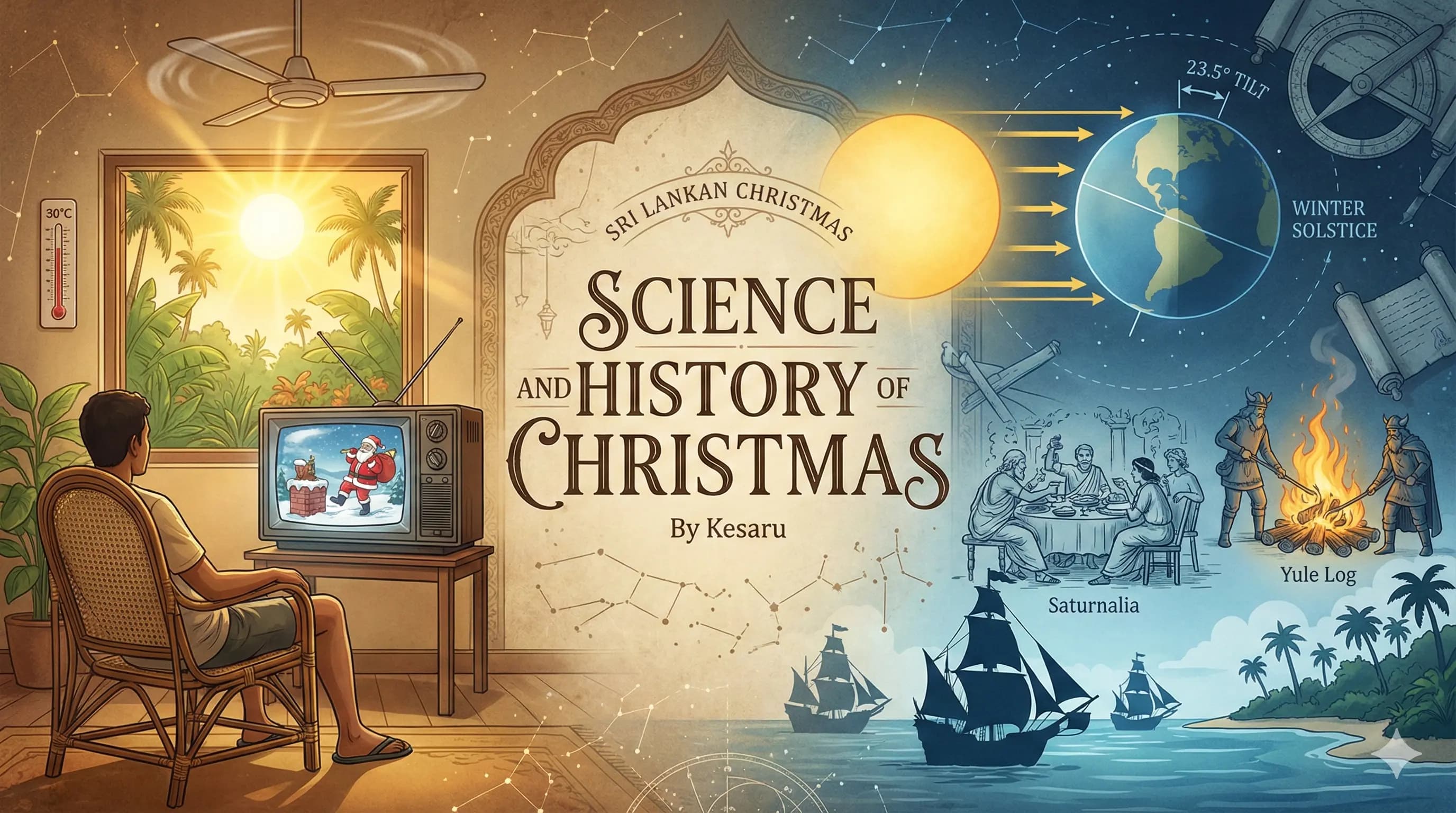
I’m sitting in front of the TV. It’s December in Sri Lanka. I’m wearing shorts because it is, quite frankly, boiling hot outside. The air is thick, the fan is spinning, and everything is humid.
But on the screen? It’s a blizzard.
I’m watching these Hollywood movies where everyone is wrapped in three layers of wool, shivering, and drinking hot cocoa. There is this fat bloke in a red suit sliding down a chimney. And I’m sitting there, looking at my own house, thinking: We don’t even have a chimney.
If Santa tried to visit a typical Sri Lankan house, he’d have to break through the roof tiles or pick the lock on the front gate.
For most of us—unless you were one of the "Colombo people" (you know the ones I mean) or from a devout Christian family—Christmas was just… weird. It felt like we were watching a broadcast from an alien planet. We didn't have the snow. We didn't have the reindeer. We certainly didn't need the warmth.
So, what did we actually do? We watched the cartoons. Maybe we went on a trip to Adam’s Peak or Anuradhapura because everyone else was on holiday. But looking back, I realize we were just going through the motions of someone else's festival.
It bugged me. I’m a guy who likes things to make sense. And Christmas in the tropics makes zero sense.
Why does the whole world stop in late December? Why do we put up plastic pine trees in shopping malls when it's 30 degrees outside? Is it really just about a birthday?
I decided to dig into it. I wanted the cold, hard facts. And it turns out, the answer has nothing to do with religion and everything to do with astrophysics.
The Geometry of Fear
The story doesn't start in Bethlehem. It starts in space.
Here is the physics part. Our planet is wonky. It doesn't spin upright; it tilts at 23.5 degrees. Because of this tilt, the Northern Hemisphere leans away from the sun in December.
For ancient people in Europe, this was terrifying. Imagine you are a farmer in 3000 BC. You don't know about orbits. All you see is the sun getting weaker every day. The nights are getting longer. The cold is killing your crops. You are genuinely scared that the sun is going to pack its bags and leave you in the dark forever.
This fear peaks on December 21st. The Winter Solstice. The shortest day of the year.
But then, the sun starts to come back.
That is why we celebrate. It’s not a birthday party; it’s a survival party. Humans were celebrating the "return of the light" thousands of years before the church even existed.
The Party Before the Prayer
Long before anyone had heard of Christmas, the Romans had Saturnalia.
This was basically a week-long excuse to go crazy. The Romans were miserable because of the cold, so they decided to do the opposite of miserable. They feasted, they drank, and they gave gifts. It was a way to manufacture happiness when the weather was trying to kill them.
Up north, the Vikings had Yule. They dragged massive logs into their houses and set them on fire—the original "Yule Log." They were literally fighting the darkness with fire.
So, when the Christians came along later, they had a problem. They couldn't just cancel the biggest party of the year. The people wouldn't stand for it. So, they rebranded it. They took the date of the "Sun God" festival and changed it to the "Son of God" festival.
Smart marketing, really.
The Ships that Brought the Snow
So how did this winter survival festival end up on a tropical island like ours?
Simple. Colonization.
When the Portuguese, Dutch, and British arrived, they brought their calendar with them. They were used to freezing Decembers, so they kept their traditions. They ate roast beef and heavy pudding in the tropical heat because that’s what they did back home.
And we just… adopted it.
But biologically, we don’t need it. In Sri Lanka, we don’t have "Seasonal Affective Disorder." We don't get depressed because of the dark, because it’s never dark here. The sun is always up.
In fact, before the Europeans arrived, our big December event was Unduvap Poya. It celebrated the arrival of the Bo Tree sapling. It was a spiritual thing, not a desperate attempt to stay warm.
The Thought Experiment
Here is a question I’ve been asking myself: If Christmas suddenly disappeared, would we care?
If you took Christmas away from people in England or Canada, they would lose their minds. Science says they need a festival in mid-winter to boost their serotonin and oxytocin levels. If they didn't have Christmas, they would invent a new festival within a few years just to survive the gloom.
But here in Sri Lanka? If Christmas vanished, I honestly think we’d be fine.
We would probably just focus on Avurudu in April. That is our real astronomical festival. That is when the sun is directly over our heads. That is when the harvest comes in. That is when our biology actually aligns with the planet.
The Conclusion
So, I’ve stopped trying to make sense of the snow on the TV.
I realized that Christmas is a bit of a cosmic accident. It’s a story about a tilted planet, a terrified ancient species, and a few ships that brought those fears to our shores.
We might not need the warmth of a Yule log in Kandy. We certainly don't need the chimneys. But humans are social animals. We like an excuse to gather. We like an excuse to eat cake.
So, even if the science doesn't quite fit our latitude, I suppose there’s no harm in enjoying the party. Just don’t expect me to wear a wool sweater.
Enjoyed this article?
Subscribe for new chronicles. No spam — just the good stuff.
Join the WhatsApp Channel
Get updates & new posts straight to your WhatsApp. No spam.
Comments
You Might Also Like
The Steering Wheel
Writing helps you see, with startling clarity, which things you are doing because you choose to, and which things you are doing because someone else, somewhere, quietly chose for you. It catches you, mid-drift, and asks the rather important question:
Iran War: Everything you should know about it as a Rational Thinker
The unwritten rules of global warfare just vanished. Following an unprecedented decapitation strike on Iran's leadership, we are witnessing a terrifying paradigm shift. From the economic domino effect of asymmetric proxy wars to the chilling reality of AI-driven military escalation, explore the undeniable mathematics of our fragile new multipolar world.
Why Scientists Hate Tech Giants: A Student’s Perspective
We often mistake the skepticism of scientists for hatred of progress. But as I discovered, they do not hate the builders; they simply want us to check the math before we jump off the cliff.